Showing posts with label pangolin foundry. Show all posts

Thursday, June 2, 2011

Visit to a bronze foundry - sand casting

Following on from Tuesday's blog, I wanted to show you a little of the sand casting work we saw on our recent visit to the  Pangolin Foundry.

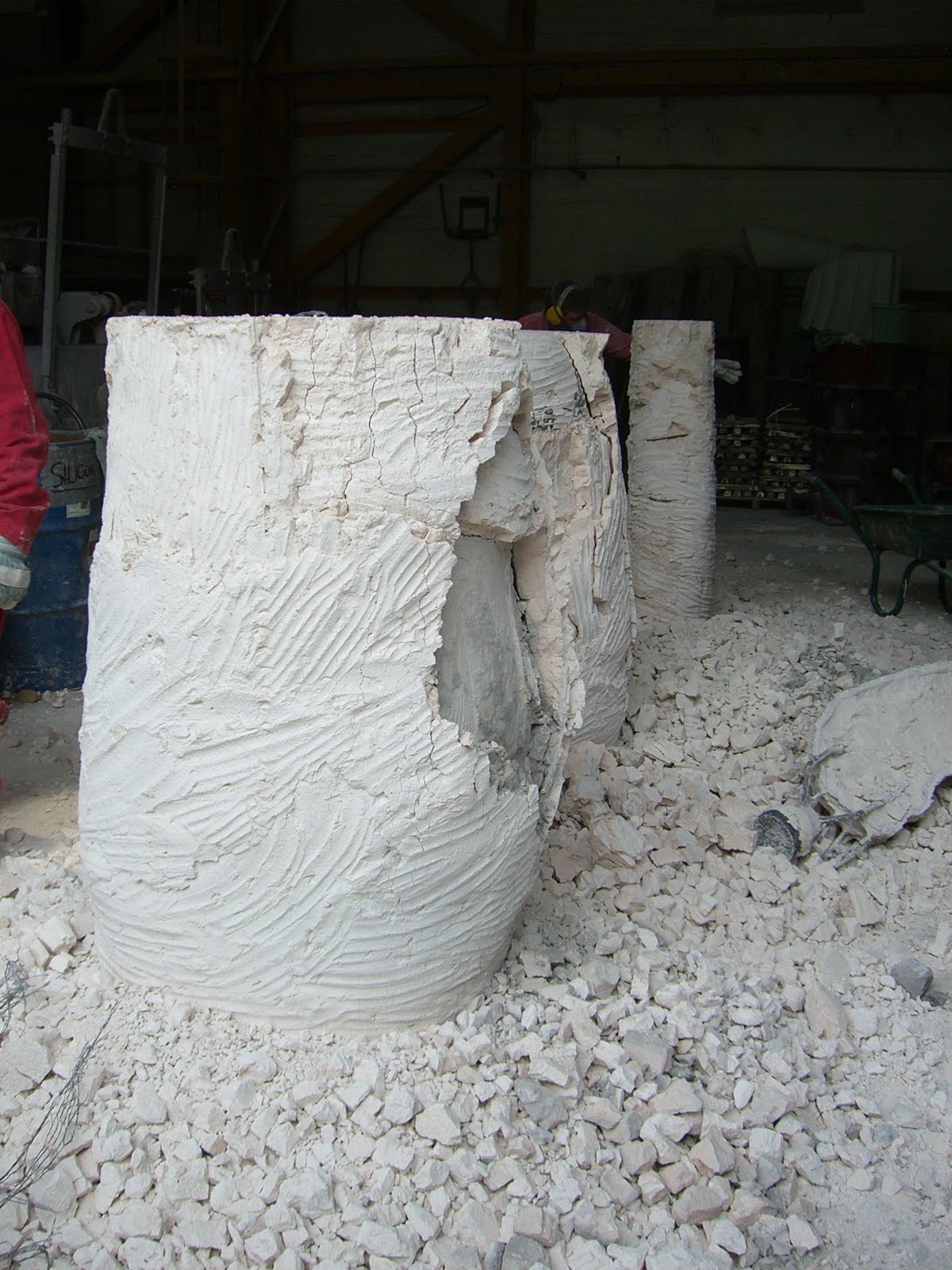
Large outdoor sculptures tend to be cast using sand for molds.  This involves huge three dimensional jigsaw puzzles of sand blocks formed around an original sculpture. The sand is mixed with sodium silicate. Tiny holes are made it the sand blocks and then carbon dioxide is put in the holes and the silicate reacts with the gas to create a glass type binding on the sand, making it a hard block.


The precision used in making the sand blocks was astounding with such straight surfaces and defined angles.


When all the blocks are made and hardened around the original, they are taken apart, the original removed and then reassembled. A core is then made, allowing a space of approx 10mm which represents the final thickness of the bronze.  The core is also made of the sand/silicate material, on a steel support frame.

The molten metal is then poured into the molds after the completed core and surrounding blocks have been encased in steel boxing.


Similar finishing work to that done on the lost wax cast sculptures is then done and patina is added.


Here are some of the other finished sculptures we saw:


Bronze covered in auto paint

Bronze Fish and Chips!

You can see this in a previous photo, upside down, before the bronze was poured in


It was an amazing tour and fascinating to see the processes involved in creating these enormous sculptures - some of them up to 100 feet tall!!

If you ever get a chance to tour one of the big foundry - go for it! You'll be fascinated too!

Tuesday, May 31, 2011

Visit to a bronze foundry - Lost Wax Casting Method

Last week we went to visit a foundry in the Cotswolds area. It's called Pangolin, named after an African anteater!  We had a fascinating day and were amazed to see all the work involved in creating their massive bronze sculptures.  Our friends who were staying with us in Cheltenham had also been with us in San Miguel de Allende earlier in the year and they, like me, had tried their hand at  wax modelling for bronze casting, so it was especially interesting to see all the phases that our sculptures had gone through.

The pangolin foundry uses both the lost wax method and also sand casting, depending on the piece.

The lost wax method dates back at least 6,000 years and the technique has not changed very much.

1. The artist first creates his sculpture using wax, clay or some other media.

2.  A mold is then made of the original sculpture.  An outer rigid mold is made from plaster or clay and an inner flexible mold is made from rubber.  Molds can be two or three parts, depending on the overhangs and include shims (wedges or tapers) so the pieces can be put back together accurately.

Clay outer mold. The wedges are the shims

Outer rigid brown/white mold with pink rubber mold

 3. A wax cast is then made by painting molten wax into the rubber mold.  Once a thin layer has been painted on, wax is poured in and out of the mold to create a thickness of 1/8" - 1/4" of wax over the whole rubber mold.

Wax in the rubber and plaster mold

4. When the wax has cooled and set, it is carefully removed from the rubber mold. A system of wax rods (runners) are then added to the wax.  These will allow the bronze/silver/gold to run into the sculpture.  Small rods (risers) are also added to allow air to escape as the metal runs in.


Refining the wax models and adding risers and runners

5. The wax model is then encased in another mold able to withstand high temperatures, so that the wax can be melted out.  This mold is made from grog - a crushed, fired clay mixed with plaster.  The grog sets quickly and a hard block is formed around the wax.  This same mixture is also poured inside the wax to form the core, as the final sculpture will be hollow.


6. The finished block is then placed upside down in a kiln and heated upto 700 degrees C. This melts the wax out of the mold.

The kiln

7. After the mold cool, they are turned the right way up and filled with molten bronze. The metal fills all the space left by the melted wax and the sculpture, including the runners and risers.

8. Once the metal cools, the mould is broken open and the raw cast sculpture is revealed.  Cracks are filled with bronze, and the risers and runners are removed.


9. The final process is then patination and a large range of colors are available.

I'll show you a little of the sand casting process on Thursday and also some final pieces...but here is one of my favorites for now:

Dodo by Nick Bibby